
Cold Laser Therapy in Williamsville, NY
Gentle, drug-free light therapy that supports your body's own repair process, offered alongside hands-on chiropractic care at Munroe Chiropractic on Main Street in Williamsville since 1987.
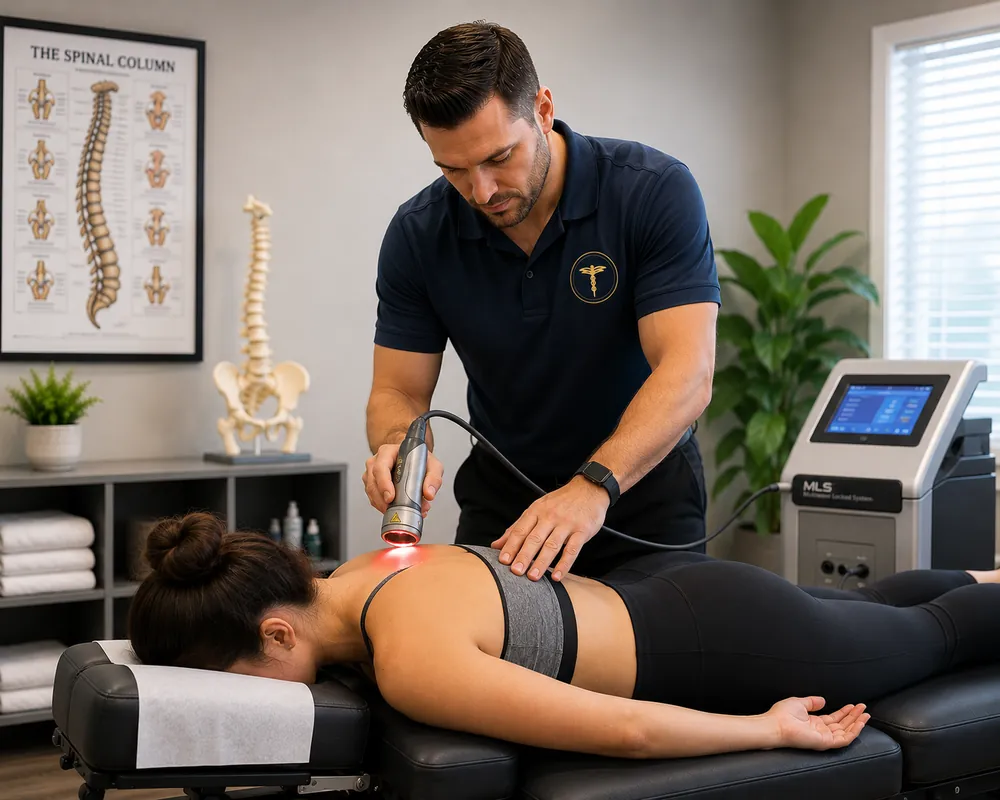
Quick answer: Cold laser therapy, also called low-level laser therapy or photobiomodulation, uses specific wavelengths of red and near-infrared light to support healing in injured or irritated tissue. It is painless, non-invasive, drug-free, and takes only a few minutes per area. At Munroe Chiropractic in Williamsville, NY, our doctors use it for plantar fasciitis, carpal tunnel symptoms, sports and soft-tissue injuries, arthritis pain, and nerve-related pain, usually as one part of a broader hands-on care plan. To ask whether it is a reasonable option for your problem, call or text (716) 632-4476.
What Cold Laser Therapy Is, and What It Is Not
Cold laser therapy is a non-invasive treatment that delivers low-intensity red and near-infrared light into tissue through a small handheld applicator held at or just above the skin. In the research literature it is usually called low-level laser therapy (LLLT) or photobiomodulation. The word cold is doing important work in that name. The output is deliberately kept low enough that it does not heat, cut, burn, or ablate tissue the way a surgical laser does. Nothing is cut, nothing is injected, and nothing is prescribed. The light simply passes into the tissue and is absorbed there.
Patients who come to our Williamsville, NY office often arrive picturing something dramatic, and then are surprised by how ordinary the experience is. There is no needle, no incision, and no recovery time. Most people feel nothing at all, or a faint warmth in the area being treated. You can drive yourself home, go back to work, and return to your normal routine the same afternoon. That quiet, low-drama quality is exactly why cold laser fits so naturally into the kind of hands-on, drug-free chiropractic care we have practiced on Main Street since 1987.
It also helps to be clear about what cold laser therapy is not. It is not a replacement for an accurate diagnosis, it is not a substitute for surgery when surgery is genuinely required, and it is not a single-visit miracle. It is a supportive therapy. Used well, in the right cases, and combined with skilled hands-on treatment and sensible home care, it can be a useful part of getting a stubborn area to calm down and move again. That framing matters to us. We would rather set an honest expectation on your first visit than have you wonder, six visits later, what you were actually signed up for.
- Non-invasive: nothing pierces or cuts the skin
- Drug-free: no medication, no injection, no prescription
- Painless for nearly everyone: typically no sensation or mild warmth
- No downtime: return to work, driving, or the gym the same day
- Focused: treatment is applied directly over the area of complaint
- Supportive: used as one part of a plan, not as a stand-alone cure
How Light Energy Supports Cellular Repair
The working explanation for cold laser therapy centers on your mitochondria, the small structures inside cells that produce usable energy. Red and near-infrared wavelengths are thought to be absorbed primarily by cytochrome c oxidase, an enzyme at the end of the mitochondrial respiratory chain. Researchers have observed that this absorption is followed by an increase in adenosine triphosphate (ATP) production, the release of nitric oxide, shifts in reactive oxygen species, and changes in intracellular calcium signaling. In plain terms, the light appears to give cells more of the energy currency they need to carry out repair, and to nudge the signals that govern how they respond to injury.
Downstream of that energy change, laboratory and clinical studies have reported effects that matter to a person in pain: improved local blood flow, modulation of inflammatory signaling, and stimulation of the cell activity involved in tissue repair and remodeling. That combination is why the therapy has been studied across such a wide range of problems, from wound healing to tendinopathy to nerve-related pain. It is also why the treatment is applied directly over the tissue in question rather than somewhere convenient. The light has to reach the cells you are trying to influence.
We want to be straightforward about the state of the evidence, because you deserve that. Photobiomodulation has been studied for decades and has a strong safety record, but the quality of the evidence varies considerably by condition. It looks more convincing for some soft-tissue and nerve-entrapment problems than for others, and published reviews consistently note that dose, wavelength, and technique matter a great deal. Professional associations in the field have issued dosing guidance for musculoskeletal complaints, yet there is still no universal agreement on ideal parameters. Our doctors treat cold laser as a well-tolerated supportive tool with promising research behind it, not as a guaranteed outcome, and we will tell you honestly if we do not think it is the right choice for your case.
Conditions We Use Cold Laser Therapy For in Williamsville, NY
Cold laser is most useful when the problem involves irritated, inflamed, or slow-healing soft tissue, or a nerve that is being compressed or chemically irritated. That covers a great deal of what walks through our doors. Runners and weekend athletes come in with heel pain and Achilles irritation. Office workers come in with wrist and hand symptoms. Tradespeople and warehouse workers come in with shoulder and elbow problems that flared up once and never fully settled. Patients recovering from a car accident come in with neck and mid-back tissue that is still guarded and sore weeks later.
Because the applicator is small and directed, we can treat a very specific spot, such as the insertion point of the plantar fascia at the heel, the carpal tunnel at the wrist, or a trigger point in the upper trapezius. That precision is one of the reasons it pairs so well with the broader hands-on work our doctors do. It lets us put attention exactly where the exam found the problem instead of treating a whole region indiscriminately. Complaints we commonly consider cold laser for include the following.
If your problem is not on this list, that does not mean we cannot help. It means we need to examine you first. Some complaints respond better to adjusting, some to Non-Surgical Spinal Decompression, some to a combination of approaches, and some need a referral elsewhere. The examination comes before the treatment plan, always. That is true for every patient who walks into our Williamsville office, whether you are here for a decades-old back problem or a heel that started hurting last month.
- Plantar fasciitis and chronic heel pain
- Carpal tunnel symptoms and other nerve-entrapment pain in the wrist and hand
- Sports injuries, including sprains, strains, and overuse tendon problems
- Soft-tissue injuries from auto accidents, including whiplash-associated neck and shoulder pain
- Work injuries affecting the shoulder, elbow, wrist, low back, or knee
- Arthritis pain and joint stiffness
- Nerve-related pain, including pain referring down the arm or leg
- Trigger points and persistent muscle guarding
- Neck pain, back pain, and pain associated with sciatica or disc irritation
- Slow-to-settle areas that remain sore after the acute phase has passed
What a Cold Laser Session Looks Like at Our Williamsville Office
Nothing about a cold laser visit is complicated, and we would rather you know exactly what to expect before you arrive. Your first appointment is not a laser session. It is an evaluation. One of our doctors takes a detailed history, examines the area, tests movement and function, and orders on-site digital X-rays when the findings call for them. Only after we understand what is actually wrong do we recommend a plan, and only then do we tell you whether cold laser belongs in it.
When cold laser is part of your care, a typical session runs like the steps below. It usually takes only a few minutes per area, which is why it slots easily into a regular treatment visit rather than requiring a separate appointment. Most patients receive it as part of a series of visits over several weeks, with a reassessment along the way so we can see whether the area is genuinely responding rather than just feeling better for an afternoon.
Reassessment is not a formality here. If we are several visits in and the objective findings have not moved, we change the plan. That might mean adjusting the approach, adding or subtracting a therapy, or referring you for imaging or a specialist opinion. Continuing a treatment that is not working is not care, it is habit, and we do not practice that way. When you have questions between visits, call or text (716) 632-4476 and a real person will get you an answer.
- Step 1: Your doctor identifies and marks the specific tissue to be treated based on your exam findings
- Step 2: Protective eyewear is provided for you and worn by the doctor or technician
- Step 3: The area is exposed, because the light needs direct access to skin, and no gel or cream is required
- Step 4: The applicator is held over or gently in contact with the area, sometimes moved slowly across it
- Step 5: Treatment time is typically a few minutes per site, depending on the area and the plan
- Step 6: You get up and go, with no downtime, no bandage, and no activity restriction from the laser itself
Who Is a Good Candidate for Cold Laser Therapy
Cold laser tends to appeal to a particular kind of patient, and we see a lot of them in Williamsville. People who cannot tolerate anti-inflammatory medication, or who simply do not want to take it. People who want to exhaust conservative, non-invasive options before they consider an injection or a surgical consult. Older adults managing arthritis pain who want something gentle. Athletes who need to keep training while a soft-tissue problem settles down. Patients recovering from an auto accident or a work injury who want steady, documented, drug-free progress they can point to.
It is also a comfortable choice for people who are apprehensive about treatment in general. There is no force applied, no manipulation involved in the laser itself, and no sensation that most people find unpleasant. For a patient who is nervous about care, or who has had a bad experience elsewhere, starting with something this gentle can be a reasonable on-ramp to the rest of a plan.
There are situations that call for caution or a different approach, and we screen for them carefully. We avoid treating directly over a known or suspected cancer, over the abdomen of a pregnant patient, over the thyroid gland, and over an area that recently received a corticosteroid injection. We ask about medications and medical conditions that increase sensitivity to light. We do not apply laser over undiagnosed pain, because the first job is always to find out what is causing it. Tell your doctor about your full health history, including anything you are being treated for elsewhere and every medication and supplement you take, so we can make a safe decision together.
- Good fit: soft-tissue injuries, tendon irritation, nerve-entrapment symptoms, arthritis pain, post-accident soreness
- Good fit: patients avoiding medication, injections, or surgery
- Needs review first: pregnancy, known or suspected cancer, photosensitizing medication, recent steroid injection, active infection, undiagnosed pain
- Not treated directly: the eyes, the thyroid gland, the abdomen during pregnancy
- Always: a full examination before any treatment recommendation
Safety, Comfort, and Honest Expectations
Photobiomodulation has been studied for decades in a substantial body of published research, and its safety profile is one of the main reasons it has become common in chiropractic offices. Reported side effects in healthy adults, when devices are used as directed and within recommended parameters, are mild and uncommon. The single non-negotiable precaution is eye protection. Laser light should never be directed toward the eyes, so protective eyewear is worn by everyone in the room during treatment. That is standard practice here, every time, with no exceptions.
As for comfort, most patients report nothing more than gentle warmth. Some feel nothing whatsoever and are mildly disappointed that a treatment involving a laser turns out to be so uneventful. There is no burning, no stinging, and no soreness afterward from the laser itself. If you do feel anything unusual during a session, tell us and we will stop and check right away.
We also owe you honest expectations. Response varies from person to person and from condition to condition. Some patients notice a change after a handful of visits, others need a longer course, and some do not respond meaningfully at all, which is true of every therapy in medicine. Cold laser is generally cumulative rather than instant, which is why it is delivered as a series rather than a one-time treatment. We will not promise you an outcome, and you should be skeptical of any office that does. What we will promise is a real examination, a plan built on your own findings, and a straight answer about whether it is working.
How Cold Laser Fits With Hands-On Chiropractic Care
Cold laser rarely stands alone in our office, and it works best when it does not have to. Think of it in layers. A chiropractic adjustment addresses how a joint moves. Soft-tissue work addresses the muscle and fascia around it. Cold laser addresses the tissue at the cellular level. When a joint has been restricted for a long time, the surrounding tissue is usually irritated and protective, and treating only one layer often leaves the problem half solved and quick to return.
Our doctors are trained in a wide range of adjusting approaches, including Diversified, Thompson Drop, Flexion-Distraction, Trigger Point Therapy, Sacro-Occipital Technique (SOT), Seated Cervical, Traction, Toggle, and Active Release Technique (A.R.T.). Depending on your presentation, cold laser may be applied before adjusting to help a guarded area relax, or after, to support the tissue that was just worked on. For disc-related complaints, it is often layered into a plan built around Non-Surgical Spinal Decompression, our flagship service, which uses technology derived from the DRX-9000 design and is led by Dr. Niccole Jefferlone and Dr. Matt Millanti.
The rest of the plan matters just as much as what happens on the table. On-site digital X-rays give us objective information when the exam calls for it. Home care, stretching, ergonomic changes, and activity guidance carry the progress between visits, and they are usually the difference between a problem that settles and a problem that keeps coming back. Massage therapy is coming soon to our Williamsville office and will give us another soft-tissue option. The goal is never to sell you a modality. It is to get the area moving, calm, and durable enough that you need us less.
Why Patients Choose Munroe Chiropractic in Williamsville, NY
Munroe Chiropractic, P.C. has been caring for this community from 6035 Main Street in Williamsville since 1987, and we have helped more than 40,000 patients in that time. Our tagline, Experience. Quality. Compassion., is not marketing filler. It is the order in which we think those things matter. In 2026 we became part of the Complete Care Chiropractic family, with the same team in the same location, which is exactly how our patients wanted it.
Your care may be delivered by Dr. Niccole Jefferlone, D.C., our owner; Dr. Safeya Muhammad, D.C., who is CACCP certified through the ICPA, Webster Technique certified, and Spinning Babies trained, with a prenatal, pediatric, and family focus after 11 years here; Dr. Matt Millanti, D.C., who brings 10 years at the practice and extensive Non-Surgical Spinal Decompression experience; or Dr. Megan Berndt, D.C., who joined us in 2026 with a master's degree in sports rehabilitation and prior experience performing acupuncture in Minnesota. Patients travel to us from Amherst, Clarence, Buffalo, and across Western New York, but Williamsville is home.
We also have deep experience with the cases other offices find complicated. No-fault (auto accident) care, workers' compensation, and personal injury claims involve documentation, timelines, and communication that we handle every week. If you were hurt in a crash on Main Street or injured on the job, you should not have to become an expert in paperwork just to get treated. We are open six days a week to make that easier: Monday through Friday from 8:00am to 7:00pm, closed for lunch from 1:00pm to 2:00pm, and Saturday from 8:00am to 2:00pm.
Getting started is simple. Call or text (716) 632-4476 and tell us what is bothering you. There is no online appointment system here, because a two-minute conversation with a real person gets you to the right doctor faster than a form does. If you prefer to arrive ready to go, new-patient paperwork can be completed ahead of time on our Paperwork page.
Frequently Asked Questions
Does cold laser therapy hurt?
No. Cold laser therapy is painless for nearly everyone. The output is far too low to heat or damage tissue, so there is no burning or stinging. Most patients feel either nothing at all or a gentle warmth over the treated area. If you ever feel anything uncomfortable during a session, tell your doctor and we will stop immediately and reassess.
How many cold laser sessions will I need in Williamsville?
It depends on your condition, how long you have had it, and how you respond. Cold laser is generally cumulative rather than immediate, so it is delivered as a series of short treatments over several weeks rather than a single visit. Your doctor will give you a specific recommendation after your examination and will reassess along the way. If the objective findings are not improving, we change the plan rather than repeating it. Call or text (716) 632-4476 to get evaluated.
Is cold laser therapy the same as a surgical laser or a tanning bed?
No. A surgical laser is high powered and designed to cut or ablate tissue. A tanning bed emits ultraviolet light. Cold laser therapy uses low-intensity red and near-infrared wavelengths that do not cut, burn, or tan. The goal is to have the light absorbed by cells so it can support their normal repair activity, not to produce heat or damage.
What conditions do you use cold laser therapy for?
We most often consider it for plantar fasciitis and heel pain, carpal tunnel symptoms, sports injuries, sprains and strains, tendon irritation, arthritis pain, nerve-related pain, trigger points, and soft-tissue injuries from auto accidents or work injuries. It is also used to support neck and back complaints alongside adjusting. The right answer for your specific problem comes from an examination, not from a list.
Can I have cold laser therapy if I am pregnant?
Cold laser is not applied directly over the abdomen during pregnancy. Depending on the situation it may still be appropriate for another area, and there are many other options available to pregnant patients here. Dr. Safeya Muhammad is CACCP certified through the ICPA, Webster Technique certified, and Spinning Babies trained, so prenatal patients are in very experienced hands. Always tell us if you are pregnant or think you may be.
Do I need eye protection during a cold laser session?
Yes. Laser light should never be directed toward the eyes, so protective eyewear is worn by you and by the doctor or technician for the entire treatment. This is the one strict safety requirement of the therapy, and we follow it on every session without exception.
Is cold laser therapy covered by my insurance or my no-fault claim?
Coverage varies widely by plan and by claim type, so we will not guess. Munroe Chiropractic has handled no-fault (auto accident), workers' compensation, and personal injury cases since 1987, and our staff can review your specific situation with you before treatment begins so there are no surprises. Call or text (716) 632-4476 and we will walk you through what your coverage looks like.
How do I make an appointment for cold laser therapy in Williamsville, NY?
Call or text (716) 632-4476. We do not use an online appointment system, because a short conversation lets us route you to the right doctor and the right first visit. We are open Monday through Friday from 8:00am to 7:00pm, closed 1:00pm to 2:00pm for lunch, and Saturday from 8:00am to 2:00pm at 6035 Main Street in Williamsville. If you would like to complete your new-patient paperwork ahead of time, you can do that on our Paperwork page.
Ready to find out whether cold laser therapy is a reasonable option for your pain? Call or text Munroe Chiropractic in Williamsville, NY at (716) 632-4476. Open six days a week at 6035 Main Street.