
Digital Spinal X-Rays in Williamsville, NY
On-site cervical, thoracic, lumbar, sacral and pelvic imaging at 6035 Main Street, so your care plan is built on what is actually happening in your spine. Experience. Quality. Compassion. since 1987.
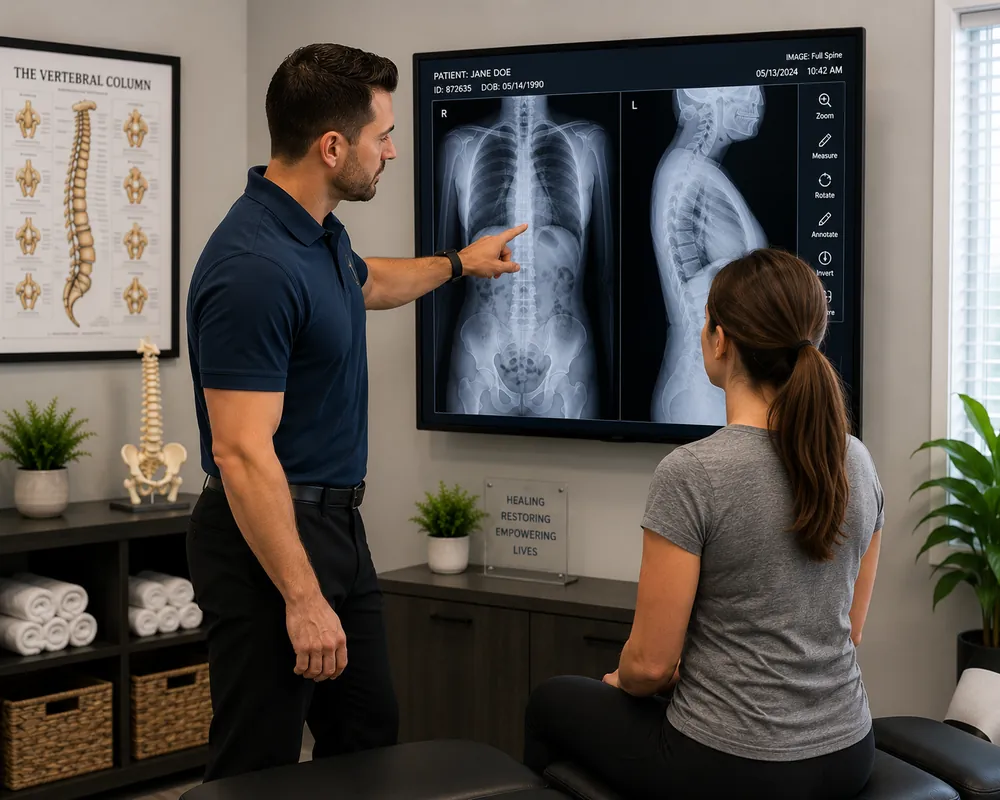
Quick answer: Munroe Chiropractic performs digital spinal X-rays on site in Williamsville, NY. Imaging is used when your history and examination call for it, such as after a car accident or work injury, when symptoms are not responding to conservative care, or when we need to confirm that a hands-on adjustment is appropriate for your spine. Digital equipment produces images in seconds and generally uses a lower radiation dose than older film systems, and your doctor reviews the results with you during the same visit. To ask whether imaging is right for you, call or text (716) 632-4476.
Digital Spinal X-Rays in Williamsville, NY: Seeing the Structure Behind Your Symptoms
A spinal X-ray is a diagnostic image that shows the bones of your spine and pelvis, the spaces between them, and the general alignment of one segment on the next. At our Williamsville, NY office at 6035 Main Street, that imaging happens on site. You do not have to drive across town to an imaging center, wait days for a disc or a written report, and then come back to talk about it. The images appear on a screen within moments of being taken, and your doctor of chiropractic reviews them with you while your history and examination findings are still fresh.
Hands-on evaluation tells us a great deal. Range of motion, muscle tone, orthopedic and neurological testing, palpation of the joints, and a careful history often point clearly toward the source of the problem. What a physical exam cannot do is see through skin and muscle to the bone underneath. Imaging fills that specific gap. It is not a substitute for a thorough examination and it is not something every patient needs, but when a clinical question depends on structure, an X-ray can answer it directly instead of leaving us to guess.
Used well, spinal imaging changes what we do rather than simply confirming what we already suspected. It can rule a technique in, rule a technique out, redirect care toward decompression rather than manual adjusting, or prompt a referral for advanced imaging or a medical opinion. That is the standard we hold it to at our Williamsville, NY practice.
- Helps confirm there is no fracture, dislocation or acute bony injury after a fall, collision or work incident
- Shows disc space narrowing, endplate changes and degenerative arthritis that help explain long-standing stiffness
- Reveals curvature, scoliosis, transitional segments and other structural variations that shape technique selection
- Documents the condition of the spine on a specific date, which matters for no-fault and workers' compensation claims
- Helps us decide whether hands-on adjusting, spinal decompression, or a referral is the safest next step
How Digital X-Ray Imaging Works and Why It Differs From Film
Traditional radiography captured the image on a sheet of film that had to be chemically developed in a darkroom. Digital radiography replaces the film with an electronic detector. X-ray energy that passes through the body strikes that detector, is converted into a digital signal, and is rendered on a monitor almost immediately. Nothing is developed, nothing is hung on a light box, and nothing gets lost in a filing cabinet.
The practical differences matter to patients. Because digital detectors are more sensitive than film emulsion, digital systems generally produce a diagnostic image at a lower radiation dose. Because the image appears at once, the doctor can confirm positioning and quality on the spot, which reduces repeat exposures caused by an unusable film. And because the image is data rather than a physical object, it can be magnified, contrast-adjusted, measured, and viewed side by side with a later study.
There is also a communication benefit. If your care involves an orthopedist, a neurologist, a physical therapist, an attorney handling a no-fault claim, or a workers' compensation carrier, a digital study can be shared without mailing a physical film that may never come back. For many Williamsville, NY patients, that single detail removes weeks of delay from a claim or a referral.
- Images available in seconds rather than after darkroom processing
- Generally a lower radiation dose than a comparable film-based study, in keeping with using the smallest reasonable exposure
- Zoom, contrast and measurement tools that make subtle findings easier to see
- Fewer retakes, because positioning and image quality are verified immediately
- Easy to store, compare over time, and share with other providers or a claims adjuster
Cervical, Thoracic, Lumbar, Sacral and Pelvic Imaging
The spine is one structure, but each region carries its own load, moves in its own way, and fails in its own patterns. Our on-site equipment images the full spinal column and the pelvis, and the region we study is chosen by your symptoms and examination, not by habit. A patient with headaches and neck stiffness is not imaged the same way as a patient with radiating leg pain after lifting at work.
Standard studies usually begin with two views taken at right angles to each other, most commonly a front-to-back view and a side view. That pairing gives a three-dimensional sense of alignment, disc spacing and bone quality. Additional views are added only when there is a reason. An open-mouth view is the projection that best shows the upper two neck bones and the odontoid, which sit hidden behind the jaw on other views. Oblique views bring the small posterior joints and the bony bridge between them into profile. Flexion and extension views, taken with the neck or low back bent forward and back, are used when instability is the clinical question and fracture has already been excluded.
Pelvic and sacral imaging deserves its own mention. The sacrum and the two sacroiliac joints sit at the base of the spinal column and transmit every step you take into your low back. Leg length difference, pelvic tilt, sacroiliac arthritis and hip joint degeneration can all show up here, and any of them can produce discomfort that a patient reads as purely low back pain.
- Cervical spine for neck pain, headaches and migraines, whiplash, vertigo and arm or hand symptoms
- Thoracic spine for mid-back pain, rib and postural complaints, and pain between the shoulder blades
- Lumbar spine for low back pain, sciatica, and suspected disc or facet involvement
- Sacrum and sacroiliac joints for pain at the belt line, buttock and tailbone region
- Pelvis and hips for gait changes, leg length asymmetry and hip-related low back pain
When a Williamsville Chiropractor Recommends Spinal Imaging
Current professional guidance is clear that spinal X-rays should not be a routine step for every person who walks through the door with an achy back. Most uncomplicated back and neck pain improves with conservative care, and imaging without a clinical reason adds exposure without adding information. We follow that thinking. Imaging at our Williamsville, NY office is ordered when your history, your examination, or your circumstances raise a question that images can actually answer.
Several situations commonly meet that threshold. Trauma is the clearest one. If you were struck in a motor vehicle collision, fell on ice on a Main Street sidewalk, or were injured on the job, we want to know the bones are intact before any hands go on your spine. Symptoms that have not responded to a reasonable trial of conservative care are another. So are findings that suggest a structural problem, such as a visible curvature, a marked leg length difference, or a segment that moves abnormally on examination.
We also image when it changes the treatment itself. Non-Surgical Spinal Decompression, our flagship service led by Dr. Niccole Jefferlone and Dr. Matt Millanti, involves sustained, precisely controlled traction of the spine. Understanding the bone quality, alignment and surgical history of that spine before beginning is part of doing it responsibly. If you are unsure whether imaging applies to your situation, call or text (716) 632-4476 and ask.
- Recent trauma, including auto accidents, sports injuries, falls and work injuries
- Pain or stiffness that has not improved after a reasonable course of hands-on care
- Numbness, tingling, weakness or other neurological symptoms in an arm or leg
- History of osteoporosis, prior spinal surgery, or previously placed hardware
- Suspected scoliosis, spondylolisthesis, instability or progressive structural change
- Planning for spinal decompression or another technique where structure guides the setup
What to Expect at Your X-Ray Visit in Williamsville, NY
Nothing about the process is complicated, and knowing the sequence in advance takes most of the anxiety out of it. Your first visit begins with paperwork, which you can complete ahead of time on our Paperwork page so your appointment time is spent with a doctor rather than a clipboard. From there, the visit follows a predictable path through consultation, examination, imaging and review.
During the imaging itself, a staff member positions you against the detector and asks you to hold still and, for chest-area views, to hold your breath for a moment. Each exposure lasts a fraction of a second. Most spinal studies involve two to four images and take only a few minutes from start to finish. You will be asked to remove jewelry, belts, and anything metallic from the area being imaged, because metal blocks the beam and creates a white shadow that hides anatomy. Comfortable clothing without zippers, snaps or underwire in the imaged region makes this easier, and a gown is available if you need one.
The most important part of the visit is the conversation afterward. Your doctor pulls the images up on a screen, points out what looks normal, points out what does not, and explains in plain language how those findings connect to the symptom that brought you in. You leave understanding your own spine, rather than holding a report full of terminology you have to look up later.
- Consultation and history, including how the injury happened and what makes symptoms better or worse
- Physical, orthopedic and neurological examination
- Digital X-rays of the indicated region, taken on site in a few minutes
- Same-visit review of the images with your doctor
- A written plan of care, including whether adjusting, decompression, therapy or referral comes first
Safety, Radiation and What It Actually Feels Like
An X-ray uses ionizing radiation, and that deserves a straight answer rather than a brush-off. The dose from a routine spinal radiograph is small, and digital equipment generally lowers it further compared with older film systems. We work from the principle of using the smallest reasonable exposure that still produces a diagnostic image, we limit the study to the region in question, we use shielding where it is appropriate for the view being taken, and we do not image a region without a clinical reason. That last point is the single biggest protection there is.
The procedure itself is painless. There is no needle, no dye, no injection and no enclosed tube. You stand or lie still, the machine makes a brief sound, and it is over. You feel nothing during the exposure. Patients who find standing uncomfortable can often be imaged in a modified position, and if you need to sit down between views, say so. Our team would rather take an extra minute than have you push through pain.
One question always deserves a direct answer before imaging: could you be pregnant? If there is any possibility, tell us before any images are taken, and we will adjust the plan. Chiropractic care during pregnancy continues without radiographs, and Dr. Safeya Muhammad, who is CACCP certified through the ICPA and Webster Technique certified, cares for prenatal and pediatric patients here every week. Imaging in children is likewise reserved for clear clinical indications, since a child has a longer lifetime ahead in which any exposure matters.
- Low-dose digital equipment and the smallest reasonable exposure for a diagnostic image
- Imaging limited to the region your symptoms and examination point to
- Shielding used where it is appropriate for the study being performed
- Always tell us if you are pregnant or think you might be
- No needles, no dye, no enclosed tube, and no sensation during the exposure
How Imaging Shapes Hands-On, Drug-Free Care
Findings on an image do not treat anybody. What matters is how those findings change the plan. A spine with significant degenerative change at one level and good mobility above it is approached differently from a spine with a young, mobile segment and an irritated disc. Knowing the difference is what lets a doctor choose a technique with confidence rather than defaulting to the same adjustment for every patient.
Our doctors use a broad set of techniques, and imaging helps match the method to the person in front of us. Diversified and Thompson Drop adjusting suit many patients well. Flexion-Distraction is often the better fit for a disc-related low back complaint. Sacro-Occipital Technique, Seated Cervical, Toggle, Traction, Trigger Point Therapy and Active Release Technique each have their place. For a patient whose images and symptoms point toward a herniated, bulging or degenerative disc, Non-Surgical Spinal Decompression may lead the plan. When soft tissue irritation is a priority, Cold Laser Therapy may be added alongside adjusting. All of it is hands-on, drug-free and non-invasive.
Imaging also tells us when chiropractic is not the whole answer. A plain radiograph cannot show a disc, a nerve root or the spinal cord directly. If your images and your examination together suggest a problem that needs an MRI, a CT scan or a medical specialist, we say so and help arrange it. Careful referral is part of good care, not a failure of it.
- Technique selection matched to your structure, age and bone quality
- Candidacy assessment for Non-Surgical Spinal Decompression
- A baseline you can be compared against later in your plan of care
- A clear trigger for referral when advanced imaging or a medical opinion is warranted
X-Rays for No-Fault, Workers' Compensation and Personal Injury Care
Munroe Chiropractic has handled no-fault, workers' compensation and personal injury cases for decades, and imaging plays a specific role in those files. Insurance carriers and, in disputed cases, attorneys work from objective findings and dated documentation. A subjective description of pain, however honest, carries less weight than a documented examination paired with a study performed on a known date shortly after the incident. Getting evaluated promptly after a collision or a workplace injury protects your health first and your claim second, and both reasons are good ones.
Because our imaging is on site in Williamsville, NY, we can evaluate you and document your condition in the same visit rather than sending you elsewhere and losing days in the process. Our staff is experienced with New York no-fault and workers' compensation paperwork, and we will explain what your case requires before you are surprised by it. If you are working with an attorney or an adjuster, records and images can be provided as needed.
If you were hurt in a car accident, at work, or in a fall and are not sure where to begin, calling is the fastest way to sort it out. Injuries from a collision frequently feel manageable for the first day or two and then stiffen considerably. Do not wait for that to happen. Call or text (716) 632-4476 and we will get you evaluated.
- Same-visit examination and imaging so nothing is delayed after an injury
- Dated, objective documentation to support a no-fault or workers' compensation file
- Experience with New York claim paperwork and carrier requirements
- Records and images provided to your attorney or adjuster on request
Why Patients Choose Munroe Chiropractic in Williamsville, NY
Munroe Chiropractic, P.C. has served this community since 1987 and has helped more than 40,000 patients in that time. We are now part of the Complete Care Chiropractic family, with the same team and the same location at 6035 Main Street in Williamsville, NY. Our approach has not changed: hands-on, drug-free, non-invasive care delivered by doctors who take the time to explain what is happening in your spine and why.
Care is provided by Dr. Niccole Jefferlone, D.C., the owner of the practice; Dr. Safeya Muhammad, D.C., who has been with the practice for eleven years and focuses on prenatal, pediatric and family care with CACCP certification through the ICPA, Webster Technique certification and Spinning Babies training; Dr. Matt Millanti, D.C., a ten-year member of the team with extensive Non-Surgical Spinal Decompression experience; and Dr. Megan Berndt, D.C., who joined in 2026 and holds a master's degree in sports rehabilitation.
We are open six days a week so care fits around a work schedule instead of competing with it. Monday through Friday we are open 8:00am to 7:00pm, closed 1:00pm to 2:00pm for lunch, and on Saturday we are open 8:00am to 2:00pm. We serve patients from Williamsville, Amherst, Clarence, Buffalo and throughout Western New York. To ask a question about spinal X-rays or to arrange an evaluation, call or text (716) 632-4476.
- Serving Williamsville, NY since 1987, with more than 40,000 patients helped
- Digital X-ray equipment on site, so no separate outside imaging appointment is needed
- Four doctors of chiropractic with prenatal, pediatric, sports rehabilitation and spinal decompression experience
- Open six days a week, including Saturday from 8:00am to 2:00pm
- Experienced with no-fault, workers' compensation and personal injury care
Frequently Asked Questions
Does every new patient at Munroe Chiropractic need spinal X-rays?
No. Imaging is ordered when there is a clinical reason for it, not as a routine step for everyone. Most uncomplicated neck and back pain responds to conservative care without radiographs. We recommend X-rays when there has been trauma, when symptoms have not improved with care, when neurological signs are present, when your history includes osteoporosis or prior spinal surgery, or when the findings will change how we treat you. If we suggest imaging, your doctor will explain exactly what question the images are meant to answer. To ask about your own situation, call or text (716) 632-4476.
How long does a spinal X-ray appointment take in your Williamsville, NY office?
The imaging itself is quick. Most spinal studies involve two to four views and take only a few minutes once you are positioned. The visit as a whole runs longer, because it includes your consultation, examination, the imaging, and the review of the images with your doctor. Because everything happens on site at 6035 Main Street in Williamsville, NY, you are not making a separate trip to an imaging center or waiting days for results.
Are digital X-rays safer than traditional film X-rays?
Digital detectors are more sensitive than film, so digital systems generally produce a diagnostic image at a lower radiation dose. Digital imaging also reduces repeat exposures, because the doctor can confirm the quality of an image immediately instead of discovering a problem after film is developed. The dose from a spinal radiograph is small in either case, and we still limit imaging to the region in question and only when there is a clinical reason for it.
Can I have spinal X-rays if I am pregnant?
Tell us before any imaging if you are pregnant or think you might be, and we will adjust the plan. Chiropractic care can continue during pregnancy without radiographs. Dr. Safeya Muhammad is CACCP certified through the ICPA, Webster Technique certified and Spinning Babies trained, and provides prenatal care at our Williamsville office. If imaging ever appears genuinely necessary during a pregnancy, that decision is made carefully and in coordination with your obstetric provider.
What can a spinal X-ray show, and what can it not show?
An X-ray shows bone well. It can reveal fractures, alignment, curvature, disc space narrowing, arthritic and degenerative change, bone density concerns and surgical hardware. It does not directly image soft tissue, so it does not show a disc, a nerve root, the spinal cord, muscles or ligaments the way an MRI does. When your examination and your images together suggest a soft tissue problem that needs to be seen directly, we will discuss a referral for advanced imaging.
Will you send my X-rays to my doctor, attorney or insurance carrier?
Yes, on request. Because our images are digital, they can be shared with an orthopedist, a neurologist, a physical therapist, a no-fault or workers' compensation carrier, or your attorney without mailing physical film. Our staff is experienced with New York no-fault and workers' compensation documentation and will explain what your particular case requires.
I was in a car accident. How soon should I be evaluated and imaged?
As soon as you reasonably can. Whiplash and other collision injuries often feel manageable for a day or two and then stiffen considerably. An early evaluation protects your health and also creates dated documentation of your condition, which matters for a no-fault or personal injury claim. We can examine you and perform any needed imaging in the same visit here in Williamsville, NY. Call or text (716) 632-4476 and we will get you in.
How do I arrange an appointment for spinal X-rays?
Call or text our Williamsville, NY office at (716) 632-4476 and our team will get you scheduled. We are open Monday through Friday 8:00am to 7:00pm, closed 1:00pm to 2:00pm for lunch, and Saturday 8:00am to 2:00pm. New patient paperwork can be completed ahead of time on our Paperwork page so more of your visit is spent with a doctor.
Call or text (716) 632-4476 to ask whether spinal X-rays belong in your care plan at our Williamsville, NY office.