
Pediatric Chiropractic in Williamsville, NY
Very gentle, hands-on, drug-free care for infants, growing children and busy teenagers, provided at 6035 Main Street in Williamsville by a team that has served Western New York families since 1987.
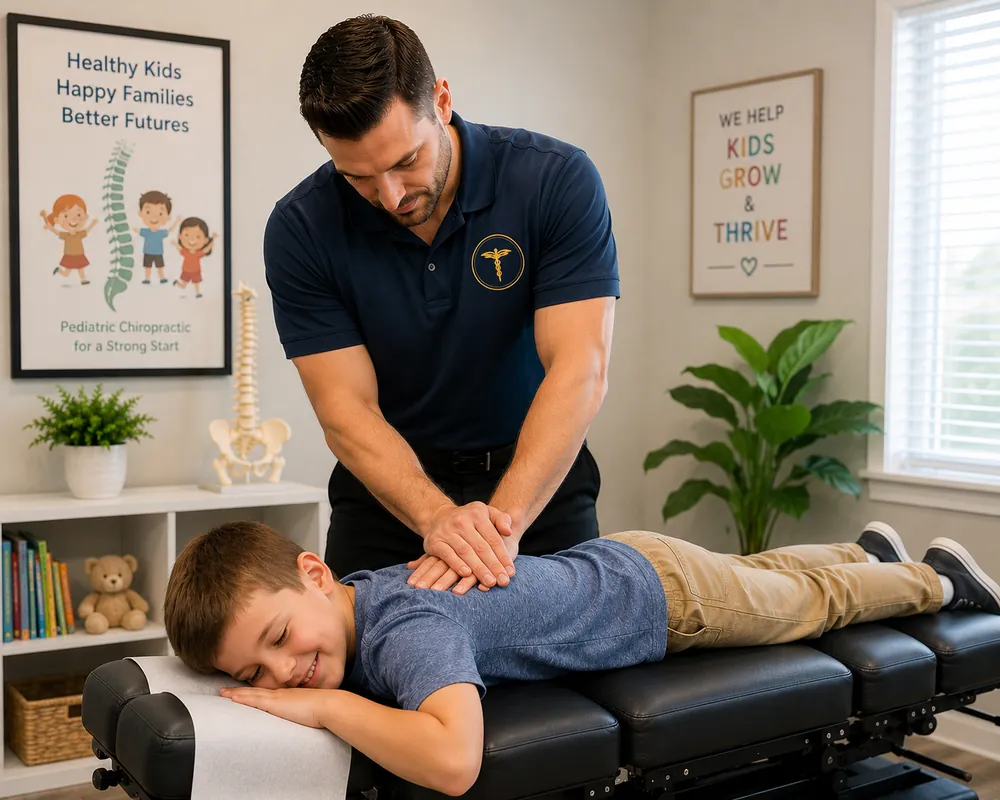
Quick answer: Pediatric chiropractic is gentle, drug-free, non-invasive care of a child's spine, pelvis and joints, adapted to the child's age and size. At Munroe Chiropractic in Williamsville, NY, infant and child adjustments use very low force, often no more pressure than a fingertip resting on the skin, with no forceful twisting and usually no popping sound. Dr. Safeya Muhammad is CACCP certified through the ICPA, Webster Technique certified and Spinning Babies trained. To ask a question or arrange a visit, call or text (716) 632-4476.
What Pediatric Chiropractic Care in Williamsville, NY Actually Is
Pediatric chiropractic is the evaluation and gentle hands-on care of a child's spine, pelvis, hips and extremities, scaled down and adapted for a body that is still growing. A newborn's spine is soft, highly mobile and shaped very differently from an adult's. A six-year-old is in the middle of a rapid remodeling phase. A fifteen-year-old athlete is carrying adult-sized loads on a frame that has not finished maturing. Care that ignores those differences is not really pediatric care. At Munroe Chiropractic, P.C. in Williamsville, NY, every part of the visit, from how we take the history to how much pressure we use, is chosen for the age of the child in front of us.
The purpose of a pediatric visit is straightforward. We look at how a child moves, where movement is restricted or guarded, how the muscles on each side compare, and whether posture and symmetry match what we would expect for that stage of development. When we find a joint that is not moving well and the surrounding soft tissue is protecting it, we use a small, specific, low-force contact to encourage normal motion, then we teach the parent what to watch for at home. It is a conservative, drug-free, non-invasive approach, and it is meant to work alongside your pediatrician rather than in place of anyone.
It also helps to be clear about what pediatric chiropractic is not. It is not a cure-all, it is not a substitute for vaccination or pediatric medical care, and no honest chiropractor will promise your child will never be sick again. The published research on chiropractic care in children is limited in both quantity and quality, and what support exists is strongest for musculoskeletal complaints. We say that plainly to parents, because families in Williamsville deserve a realistic conversation rather than a sales pitch.
- Evaluation of spinal and joint motion, muscle tone and postural symmetry, adapted to the child's age
- Very low force adjusting techniques for infants, children and adolescents
- Drug-free and non-invasive, with no injections and no medication
- Guidance for parents on positioning, tummy time, backpacks, sleep posture and sport loads
- Prompt referral when the exam suggests something outside the scope of chiropractic care
How Gentle Pediatric Adjustments Differ From Adult Care
The single most common question we hear from parents in Williamsville is whether we do the same thing to a child that we would do to an adult. We do not. Adult care often involves a quick, specific thrust that produces an audible release. Techniques used with infants and small children are gentle and low force by design. For a baby, the contact is typically a single fingertip and a sustained, feather-light pressure, often described in pediatric chiropractic training as no more pressure than you would use to check whether a tomato is ripe. There is no forceful twisting of the neck, no cracking and, in most infant visits, no sound at all.
As children grow, the technique grows with them. A toddler may receive light fingertip contacts and gentle mobilization. A school-age child may be a good fit for a drop table technique such as Thompson Drop, where a small padded segment of the table does most of the work and the doctor's force stays minimal. Flexion-Distraction is a slow, rhythmic, traction-based method that many older children and teens find relaxing. Teenagers with sports complaints may benefit from soft tissue work such as Trigger Point Therapy or Active Release Technique alongside a light adjustment. Our doctors are trained in Diversified, Thompson Drop, Flexion-Distraction, Sacro-Occipital Technique, Seated Cervical, Toggle, Traction, Trigger Point Therapy and A.R.T., which gives us room to choose the gentlest method that fits the child.
Force is always the last variable we increase and the first one we reduce. If a child is guarding, tired, hungry or simply not in the mood, we adapt or we stop. Nothing about pediatric chiropractic should require holding a child still against their will, and a parent stays with the child for the whole visit.
Why Williamsville Parents Bring Infants and Babies In
Birth is a physical event for the baby as well as the mother. Long labors, rapid deliveries, posterior positioning, vacuum or forceps assistance and cesarean birth all place mechanical stress on a newborn's neck and upper back. Parents in Williamsville and the surrounding Amherst and Clarence area often bring an infant to us when they notice a strong one-sided preference: the baby turns easily to the right but fights turning to the left, nurses comfortably on one side and struggles on the other, or always sleeps with the head rotated the same direction. Those asymmetries are exactly what a pediatric chiropractic exam is designed to evaluate.
Common reasons families ask about infant care include torticollis and head-turning preference, difficulty latching on one side, an infant who arches or seems uncomfortable when placed on the back, dislike of tummy time, and general restlessness that has already been checked out by the pediatrician. It is important to be honest here. Many infant complaints are self-limiting and improve with time regardless of treatment, and the evidence for chiropractic care in non-musculoskeletal infant conditions is weak. What we can reasonably assess and address is restricted joint motion and muscular asymmetry in the neck, upper back and pelvis, and we will tell you directly if we do not believe we are the right provider for your baby.
We also screen carefully. Poor feeding, unusual floppiness or rigidity, fever, missed developmental milestones or any sign of illness sends a family straight back to their pediatrician, and we say so on the first visit.
- Head-turning preference or torticollis noticed in the first weeks
- One-sided latching or feeding difficulty
- Discomfort with tummy time or with lying flat
- Persistent fussiness after medical causes have been ruled out
- Follow-up after a long, rapid or assisted delivery
Backpacks, Screens and Sports: Care for School-Age Kids and Teens
Older children are a very different conversation. Back and neck complaints in school-age kids are more common than most parents expect, and the usual contributors are not mysterious. Overloaded backpacks are a leading preventable cause, which is why commonly cited guidance is to keep a school pack at roughly ten to fifteen percent of the child's body weight, with some organizations recommending closer to ten percent, and to wear it on both shoulders. Hours spent looking down at a phone or a laptop load the neck and upper back in a sustained flexed position, and studies have found associations between heavy daily screen and phone use and neck and non-specific back pain in adolescents. Add year-round single-sport training, growth spurts and long stretches of sitting, and the pattern becomes predictable.
This is where hands-on chiropractic care tends to be most useful and where the evidence is strongest, because these are mechanical, musculoskeletal problems. A typical teen visit at our Williamsville office includes a movement and posture assessment, work on the restricted segments and the overworked soft tissue around them, and specific homework: how to load the backpack, how to set up a desk and a screen, which muscles need stretching and which need strengthening, and how to warm up before practice. Teenagers respond well when the plan is explained to them rather than about them, so we talk to the athlete directly.
We also see school-age children and teens after car accidents. Young passengers can develop whiplash-type neck pain, headaches and mid-back complaints even in collisions that looked minor, and symptoms sometimes appear a day or two later. Our practice has decades of experience with New York no-fault documentation, so families are not left navigating that paperwork alone.
- Backpack weight, fit and how the pack is actually carried
- Neck and upper back strain from phones, tablets and laptops
- Sport-specific overuse in athletes who play one sport year round
- Growth spurt aches, posture changes and flexibility loss
- Sprains, strains and whiplash-type injuries after a fall or a car accident
Dr. Safeya Muhammad, CACCP Certified Through the ICPA
Pediatric care is a specialty, and credentials matter. Dr. Safeya Muhammad, D.C. holds the CACCP, the Certificate in Chiropractic Pediatrics awarded by the Academy Council of Chiropractic Pediatrics through the International Chiropractic Pediatric Association. That certification is not a weekend seminar. The ICPA pediatric certification is a two hundred hour program covering care from newborn through adolescence, with a required block of in-person seminar hours, an examination after each course and a final capstone exam. She is also certified in the Webster Technique, a specific pelvic assessment and adjustment protocol developed for pregnancy, and she is Spinning Babies trained.
Dr. Muhammad has been part of this practice for eleven years and focuses on prenatal, pediatric and family care. That combination matters more than it might sound. The same doctor who cared for a mother through pregnancy is often the one who evaluates the baby afterward, which means continuity, context and a parent who already knows and trusts the person doing the exam. It is one reason families here often end up bringing more than one generation through the same door.
She practices alongside Dr. Niccole Jefferlone, D.C., the owner of Munroe Chiropractic; Dr. Matt Millanti, D.C., who has ten years with the practice and extensive Non-Surgical Spinal Decompression experience; and Dr. Megan Berndt, D.C., who joined in 2026 and holds a master's degree in sports rehabilitation. That bench depth means an active teenager, a pregnant mom and a grandparent with disc pain can all be cared for under one roof at 6035 Main Street in Williamsville, NY.
What to Expect at Your Child's First Visit, Step by Step
Parents almost always relax once they know the sequence, so here it is. New-patient paperwork is completed on our Paperwork page before you arrive or in the office at check-in, whichever is easier. We ask about pregnancy and birth history, feeding, sleep, milestones, injuries, sports, prior medical care and what specifically prompted the visit. For infants, the birth story is genuinely useful clinical information, so bring the details you remember.
Next comes the examination. We watch how your child moves, sits, stands and walks, we compare side to side, and we assess joint motion with light hands. For babies, most of the exam happens on a parent's lap or on a padded table with a parent right beside them. Nothing is hurried. If the history or exam raises a concern that falls outside chiropractic care, we say so and refer, and we are glad to coordinate with your pediatrician when that makes sense.
Then we explain what we found in plain language before we do anything. If care is appropriate, the first adjustment is gentle and brief, often only a minute or two of actual contact for a small child. You will leave knowing what we found, what we did, what to watch for over the next day or two, and what we recommend at home. On-site digital X-rays are available in our Williamsville office, but with children we are deliberately conservative and image only when the clinical picture genuinely calls for it. If you want to talk any of this through before you come in, call or text (716) 632-4476.
- Paperwork on our Paperwork page or in the office at check-in
- Detailed history covering birth, feeding, milestones, injuries and activity
- Hands-on movement, posture and symmetry examination, parent present throughout
- Findings explained in plain language before any care is provided
- A gentle, brief adjustment when appropriate, plus at-home guidance for parents
Safety, Comfort and What It Feels Like for a Child
Safety is the question behind almost every other question parents ask, so let us answer it directly and without overstating anything. The techniques used with pediatric patients are gentle and low force rather than the higher-velocity methods used with adults. Published reviews of manual and chiropractic care in children report that the adverse effects described in the literature are typically mild and temporary, such as brief soreness, increased crying or irritability, and that serious adverse events appear to be very rare. Those same reviews are equally clear that high-quality pediatric research is limited and that a reliable rate cannot be calculated from the studies available, and we do not pretend otherwise.
Most children are simply not bothered by the visit. Infants frequently sleep through it or nurse afterward without a fuss. Older kids describe it as a light press or a quick, painless movement. Because the force is so small with young patients, there is often no popping sound at all, which surprises parents who expect what they experienced during their own adjustment. A child who is sore afterward is usually mildly sore for a few hours, similar to how a muscle feels after a new activity, and it settles quickly.
Screening is the other half of safety. Fracture, active infection, bone tumors and acute inflammatory joint disease are contraindications to spinal manipulation, and signs such as fever with neck stiffness, night pain that wakes a child, unexplained weight loss, new numbness or weakness, a new spinal curvature, or symptoms following significant trauma prompt medical referral rather than chiropractic treatment. Knowing when not to adjust is a core part of the job, and we would rather send you elsewhere than guess.
How Pediatric Chiropractic Fits With the Rest of Your Family's Care
Chiropractic care works best as one part of a child's overall health picture, not as a replacement for it. Your pediatrician remains the primary medical provider for growth, development, illness, immunizations and everything else. Our role is narrower and mechanical: assessing and addressing joint motion, muscle tone and posture, and giving parents practical guidance. When a child's situation would benefit from more than one set of eyes, we are happy to communicate and co-manage, and if we take any imaging we can forward it along for coordination of care.
Care also fits naturally into what the rest of the family is already doing here. Many pediatric patients arrive because a parent is already a patient. A mother receiving prenatal chiropractic care during pregnancy often brings the baby in after birth. A father being treated after a work injury asks us to look at his son's shoulder. Because we care for every age under one roof in Williamsville, appointments can frequently be stacked so one trip down Main Street covers more than one family member.
Frequency is individualized and finite. We do not sell open-ended plans for children. A short course of care with a clear goal, followed by reassessment and a decision to continue, taper or finish, is the standard we hold ourselves to.
Why Williamsville Families Choose Munroe Chiropractic
Munroe Chiropractic, P.C. has been at 6035 Main Street in Williamsville, NY since 1987, and more than 40,000 patients have been helped here in that time. That longevity is the practical reason many local families trust us with their kids. Our approach has not changed either. Experience, quality and compassion is not a slogan we hang on the wall and ignore, it is the standard we hold every visit to, including the very short ones with very small patients.
Access matters when you have children. We are open six days a week, Monday through Friday from 8:00am to 7:00pm with a lunch closure from 1:00pm to 2:00pm, and Saturday from 8:00am to 2:00pm. That means before school, after practice and Saturday morning options without pulling a child out of class. We also carry deep experience with no-fault, workers' compensation and personal injury cases, which matters when your child was a passenger in a collision and the insurance paperwork has to be right. We are part of the Complete Care Chiropractic family as of 2026, with the same team and the same Williamsville location.
When you contact us, you reach a person rather than a form. To ask whether pediatric chiropractic makes sense for your child, or to arrange a visit, call or text (716) 632-4476 and we will talk it through with you honestly, including telling you when we think another provider is the better fit.
- Serving Williamsville, NY and nearby Amherst, Clarence and Buffalo since 1987
- CACCP certified pediatric care through the ICPA, plus Webster Technique certification
- Open six days a week, including Saturday mornings, at 6035 Main Street
- Experienced with no-fault, workers' compensation and personal injury claims
- Drug-free, non-invasive, hands-on care for the entire family under one roof
Frequently Asked Questions
Is chiropractic care safe for a newborn or infant?
Techniques used with infants are gentle and low force, typically a sustained fingertip pressure rather than the quick thrust used with adults, and there is no forceful twisting of the neck. Published reviews report that adverse effects described in children are usually mild and temporary, such as brief soreness or increased fussiness, and that serious adverse events appear to be very rare, while also noting that high-quality pediatric research is limited. We screen every infant carefully and refer to your pediatrician when anything falls outside our scope. If you have questions before scheduling, call or text (716) 632-4476 and we will answer them.
How much force is used when you adjust a baby?
Very little. For an infant, the contact is usually one fingertip and a light, sustained pressure, often described as no more than the pressure you would use to test whether a tomato is ripe. There is no cracking, no twisting and, in most infant visits, no sound at all. As a child grows we may use a drop table, gentle flexion-distraction or light soft tissue work, but force is always the last thing we increase and the first thing we reduce.
What does CACCP certified through the ICPA mean?
CACCP stands for the Certificate in Chiropractic Pediatrics awarded by the Academy Council of Chiropractic Pediatrics through the International Chiropractic Pediatric Association. The ICPA pediatric certification is a two hundred hour program covering care from newborn through adolescence, with a required block of in-person seminar hours, coursework examinations and a final capstone exam. Dr. Safeya Muhammad holds that certification and is also Webster Technique certified and Spinning Babies trained.
What are the most common reasons parents in Williamsville bring children in?
For infants, the most common reasons are a strong head-turning preference or torticollis, one-sided latching difficulty, discomfort during tummy time and general restlessness after medical causes have been ruled out. For school-age children and teens, it is usually neck and back complaints tied to heavy backpacks, long hours on screens, growth spurts, sport overuse, sprains and strains, headaches and injuries from falls or car accidents.
Will my child need X-rays?
Usually not. On-site digital X-rays are available at our Williamsville office, but with children we are deliberately conservative and image only when the history and examination genuinely call for it. If we do recommend imaging, we will explain exactly why before anything is taken, and we can forward copies to your child's pediatrician for coordination of care.
How many visits will my child need?
It depends entirely on the child, the complaint and how long it has been present, so we will not quote a number before we have examined your child. We do not sell open-ended plans for children. Our approach is a short, defined course of care with a clear goal, followed by a reassessment and an honest decision to continue, taper or finish, and we will tell you when we think you are done.
Does pediatric chiropractic replace seeing our pediatrician?
No, and it should not. Your pediatrician remains your child's primary medical provider for growth, development, illness and immunizations. Our role is mechanical: assessing and caring for joint motion, muscle tone and posture with drug-free, non-invasive methods. We refer promptly when the exam suggests something outside chiropractic care, including fever with neck stiffness, night pain that wakes a child, unexplained weight loss, new weakness or numbness, or symptoms following significant trauma.
How do we arrange a pediatric visit in Williamsville, NY?
Call or text (716) 632-4476. You will be speaking with a real person who can answer your questions first. New-patient paperwork is completed on our Paperwork page or in the office at check-in. We are open Monday through Friday from 8:00am to 7:00pm, closed from 1:00pm to 2:00pm for lunch, and Saturday from 8:00am to 2:00pm at 6035 Main Street in Williamsville, NY.
Have a question about gentle chiropractic care for your child? Call or text Munroe Chiropractic in Williamsville, NY at (716) 632-4476.