
Prevention and Wellness Chiropractic Care in Williamsville, NY
Hands-on, drug-free, non-invasive care that helps you stay well instead of waiting for the next flare-up. Serving Williamsville and Western New York since 1987.
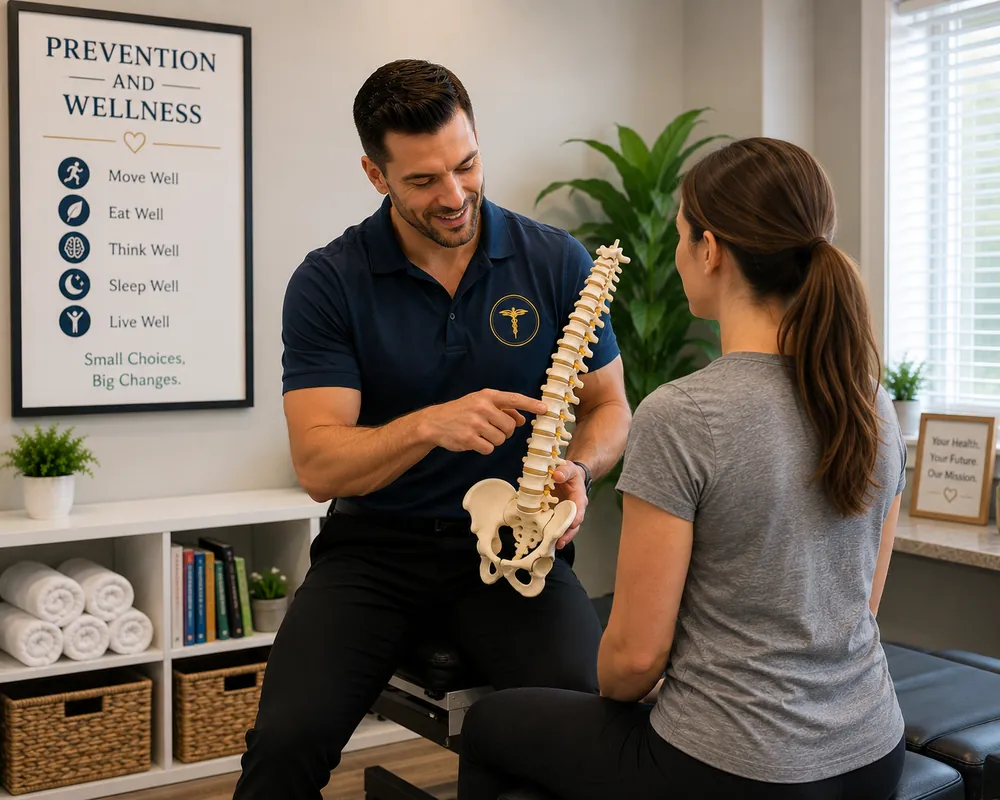
Quick answer: Wellness care, also called maintenance care, is planned chiropractic care delivered at a steady interval after an active problem has settled. Instead of returning only when pain comes back, you and your doctor set a schedule that keeps the spine moving well and catches restrictions early. At Munroe Chiropractic in Williamsville, NY, that means hands-on adjustments, soft-tissue work, and practical movement guidance, with no drugs and no surgery. To start or restart wellness care, call or text (716) 632-4476.
What Wellness Care Actually Means at a Williamsville, NY Chiropractic Office
Most people first walk through our door on Main Street because something hurts. A disc flares up after a weekend of yard work, a headache pattern will not break, or a car accident leaves the neck stiff and guarded. Care in that moment has one job, which is to calm the problem down and restore normal movement. Prevention and wellness care is what comes after that job is finished. Rather than waiting for the next episode, you and your doctor agree on a planned, low-frequency schedule that keeps the spine moving well.
In the research literature this approach is usually called maintenance care or supportive care, and the defining feature is simple. Visits are scheduled in advance based on your clinical history and examination findings rather than triggered by a phone call after the pain returns. At Munroe Chiropractic in Williamsville, NY, wellness care follows the same principles that have guided the practice since 1987. It is hands-on, it is drug-free, and it is non-invasive. Nothing about a wellness visit requires medication, injection, or surgery, and nothing about it locks you into a schedule you did not agree to.
The distinction matters because it changes the goal of a visit. In an active episode we are chasing symptoms. In wellness care we are watching function, which means how freely each segment moves, how the surrounding muscles behave, and whether the pattern that caused your last episode is quietly rebuilding itself.
- Adjustments delivered at an interval you and your doctor set together, often monthly or every several weeks
- A short reassessment of posture, spinal motion, and any old problem areas
- Soft-tissue work such as Trigger Point Therapy or Active Release Technique where muscles are guarding
- Practical guidance on movement, lifting, workstation setup, and sleep position
- An honest review of whether continued visits are still earning their place in your routine
How Maintenance Chiropractic Protects Spinal Function
The spine is not one rigid column. It is a stack of movable vertebrae protecting the spinal cord, with a pair of nerve roots exiting at nearly every level. Those joints are built to glide. When a segment stops moving normally, whether from an old injury, a repeated awkward task, or hours spent seated, the surrounding muscles guard and the joint capsule stiffens. Neighboring segments then take on extra motion to compensate, and over time that uneven load is what patients often experience as the same recurring ache in the same familiar spot.
A chiropractic adjustment applies a controlled, specific force to a restricted joint to restore normal motion. Research into how that works points to effects on the way the nervous system processes input from the spine. Studies of spinal manipulation describe changes in segmental pain processing, including reduced temporal summation of pain, which is the wind-up effect that makes repeated stimulation feel progressively worse. That is the honest version of the nervous-system explanation. Manipulation appears to influence how pain signals are handled and how well joints and muscles report their position. It is not a claim that adjustments prevent unrelated diseases, and we do not make that claim.
Because the goal is function rather than symptom chasing, every wellness visit starts with a short look at how your spine is actually behaving today.
- Segmental motion, meaning which joints glide freely and which have become restricted
- Muscle tone and tenderness, especially in areas that guarded during your original episode
- Posture and gait, including how you carry load through the hips and shoulders
- Any change in strength, sensation, or reflexes that would call for further workup
- Whether an old surgical site, disc problem, or accident injury is behaving differently
Who Wellness Care in Williamsville, NY Is Really For
Wellness care makes the most sense for people whose problems come back. If you have had two or three episodes of low back pain, or a neck and headache pattern that returns every few months, you are not dealing with a single injury. You are dealing with a recurring condition, and recurring conditions tend to respond better to a plan than to a series of emergencies. The same holds if your work or your hobbies keep loading the spine the same way, week after week.
It is worth being straightforward about the other side of this. Not everyone needs ongoing care. Research on maintenance care suggests the benefit is not uniform, and that it works best when it is applied selectively, offered to patients whose history and clinical picture actually point toward recurrence. Some people do just as well returning only when symptoms appear. If your examination points that direction, your doctor will say so. You should expect that conversation rather than a standing appointment you never asked for.
- Patients recovering from an auto accident or work injury who finished active treatment but still stiffen under stress
- Tradespeople, nurses, drivers, warehouse staff, and anyone lifting or twisting all day
- Desk-based workers holding a fixed posture for eight or more hours
- Runners, golfers, hockey and lacrosse players, and weekend athletes who want to keep training
- Adults managing degenerative disc disease, spinal stenosis, or arthritis pain
- Older adults whose main goal is staying mobile, independent, and steady on their feet
- Growing families who want one office caring for everyone, from prenatal through the kids
What the Research Says About Reducing Recurrence
The most useful evidence on this question comes from the Nordic Maintenance Care Program, a pragmatic randomized controlled trial published in PLOS One. Patients with recurrent or persistent non-specific low back pain who responded early to chiropractic care were randomized either to planned maintenance visits or to symptom-guided care, meaning they returned only when pain came back. Over fifty-two weeks, the maintenance group reported fewer days with bothersome low back pain than the symptom-guided group, on the order of thirteen fewer bothersome days across the year, while attending only a small number of additional visits on average.
A secondary analysis of the same trial added useful detail. Among patients whose psychological profile showed a more difficult pattern of coping with pain, maintenance care was associated with shorter acute episodes and longer pain-free stretches between them, without requiring more treatment than the comparison group. That is a fair description of what wellness care is trying to accomplish. It is not a promise that you will never have another flare-up. It is a plan built around making flare-ups less frequent, shorter, and easier to settle when they do happen.
We also want to be clear about the limits of the evidence. Reviews examining whether chiropractic care can prevent conditions outside the musculoskeletal system have not found support for that idea. Our wellness recommendations stay inside the area where the evidence lives, which is spinal pain, joint function, mobility, and the recurrence of musculoskeletal episodes. If you have a health concern outside that scope, we will tell you plainly and help you get to the right provider.
What a Wellness Visit Looks Like, Step by Step
Wellness visits are shorter and more focused than the initial visits you had during an active episode, and most patients are in and out efficiently. The rhythm is consistent, which is part of the point. You should always know what is happening and why, and you should leave with something to do between visits rather than only something that was done to you.
If something new turns up, the visit changes accordingly. On-site digital X-rays let us image an area the same day when a finding warrants it, rather than sending you elsewhere and waiting on a report. If a wellness patient arrives with a genuinely new problem, such as a fresh disc flare or a crash injury, we shift back into active treatment and discuss whether Non-Surgical Spinal Decompression or cold laser therapy belongs in the plan.
- Check-in and a brief interview about what has changed since your last visit
- A focused reassessment, including motion palpation of the spine and a look at posture and gait
- The adjustment itself, using the technique that fits your body and your findings, drawn from Diversified, Thompson Drop, Flexion-Distraction, Sacro-Occipital Technique, Seated Cervical, Toggle, and Traction
- Soft-tissue work as needed, using Trigger Point Therapy or Active Release Technique
- Home instructions such as a stretch, a strengthening progression, or an ergonomic change
- Scheduling your next visit at the front desk before you leave, at the interval your plan calls for
What a Wellness Plan Looks Like Over Time in Williamsville, NY
Care at our office generally moves through phases. The first is relief, where visits are more frequent and the goal is calming symptoms. The second is stabilization, where frequency drops and the focus shifts to holding the correction, rebuilding tolerance, and addressing the habits that contributed to the problem. Wellness care is the third phase, and it looks very different from the first. In the Nordic trial, maintenance visits were preplanned at intervals of roughly one to three months, set by clinical judgment rather than a fixed formula, and that range is a fair picture of what many of our wellness patients follow.
Intervals are not permanent. A landscaper heading into spring cleanup may move to a tighter schedule for a couple of months, then stretch back out in the fall. A patient with a long-standing disc problem may need a steadier cadence year-round. Someone whose spine has been quiet for a year may drop to a check every few months or step away entirely. Your plan should reflect your life, not a template, and adjusting it is as simple as saying so at your next visit or calling or texting (716) 632-4476.
- Working well: flare-ups are less frequent, shorter, and less intense than they used to be
- Working well: you keep up with work, training, and family activity without planning around your back
- Working well: you rely less on over-the-counter pain relievers to get through the week
- Call sooner: pain that is sharper, different, or spreading into an arm or leg
- Call sooner: new numbness, tingling, or weakness
- Call sooner: a new accident, fall, or lifting injury, or a flare-up not settling within a few days
Safety, Comfort, and What an Adjustment Feels Like
Chiropractic adjustment has a well-documented safety profile for musculoskeletal complaints, and the most common experience after a visit is a mild one. Prospective studies report that roughly half of patients notice some temporary local soreness, stiffness, or tiredness, usually starting within the first few hours and typically resolving on its own within a day or two. Serious complications are considered rare, and systematic reviews of adverse events, including reviews focused on older adults, have not identified serious harms as a common outcome of care.
Careful screening matters because not every spine should be adjusted the same way. Conditions such as significant osteoporosis, spinal instability, inflammatory arthritis, certain vascular histories, and recent fracture all change the plan. That is why your history and examination are revisited rather than assumed, and why our doctors keep a range of techniques available. Low-force options such as Thompson Drop, Flexion-Distraction, and Sacro-Occipital Technique let us deliver effective care to patients who should not receive a traditional high-velocity adjustment, including many pregnant patients, older adults, and children.
As for the sensation itself, most adjustments take a second or two. You are positioned carefully, your doctor makes contact with a specific joint, and a quick, shallow, precise movement follows. The audible pop many people associate with chiropractic is a gas bubble releasing inside the joint fluid, not bones grinding, and it is not a measure of whether the adjustment worked. Plenty of effective adjustments make no sound at all. Most patients describe the immediate feeling as release or relief.
How Wellness Care Fits With the Rest of Your Health Routine
Wellness chiropractic works best as one piece of a larger picture, not a replacement for the rest of it. The spine responds to what you ask of it, so the strongest results tend to show up in patients who pair regular adjustments with movement they genuinely enjoy and will keep doing. Walking, resistance training, swimming, mobility work, and simply breaking up long stretches of sitting all support the same goal, which is a spine that tolerates load without complaint.
Wellness care also coordinates with the rest of your care team. We work alongside primary care physicians, orthopedists, physical therapists, and pain management providers, and we refer out when a problem sits outside what conservative chiropractic care should handle. Within our own office, wellness patients may combine adjustments with cold laser therapy for a stubborn soft-tissue area, or with Non-Surgical Spinal Decompression for a disc problem that needs more than manual care. Massage therapy is coming soon to the Williamsville office as well.
- A short daily mobility routine for the specific segments that stiffen on you
- Progressive strengthening for the hips, glutes, and deep trunk muscles
- Workstation adjustments, including monitor height, chair support, and standing intervals
- Sleep position and pillow height changes that stop reproducing the same morning stiffness
- Lifting mechanics for the specific tasks your job or hobby demands
Why Patients Choose Munroe Chiropractic for Wellness Care in Williamsville, NY
Munroe Chiropractic, P.C. has practiced at 6035 Main Street in Williamsville since 1987, and more than 40,000 patients have been helped here in that time. Since 2026 the practice has been part of the Complete Care Chiropractic family, with the same team in the same building. Our doctors bring different strengths to wellness care. Dr. Niccole Jefferlone, D.C. owns the practice and leads our Non-Surgical Spinal Decompression program alongside Dr. Matt Millanti, D.C., who has ten years here and extensive decompression experience. Dr. Safeya Muhammad, D.C. is CACCP certified through the ICPA, Webster Technique certified, and Spinning Babies trained, with eleven years at this practice and a prenatal, pediatric, and family focus. Dr. Megan Berndt, D.C. joined in 2026 with a master's degree in sports rehabilitation.
Practical details matter for a plan you are meant to keep. We are open six days a week, Monday through Friday from 8:00am to 7:00pm with the office closed from 1:00pm to 2:00pm for lunch, and Saturday from 8:00am to 2:00pm. That range makes it realistic to fit a wellness visit around a work shift or a Saturday morning. We also carry deep experience with no-fault auto accident claims, workers' compensation, and personal injury cases, which matters for the many wellness patients who first came to us after a crash or an on-the-job injury. Patients travel to us from Williamsville, Amherst, Clarence, Buffalo, and across Western New York. Experience. Quality. Compassion. To set up wellness care, call or text (716) 632-4476.
Frequently Asked Questions
How often should I come in for wellness care?
There is no universal number. In the Nordic maintenance care trial, preplanned visits fell at roughly one to three month intervals, set by clinical judgment rather than a formula, and many of our wellness patients land in that range. Your interval depends on your history of recurrence, the physical demands of your work, how your spine has behaved since your last visit, and what your examination shows. Your doctor will recommend a starting cadence and adjust it as your situation changes. To discuss an interval that fits your life, call or text (716) 632-4476.
Is wellness chiropractic care actually supported by research?
For recurring musculoskeletal problems, yes. A pragmatic randomized controlled trial published in PLOS One found that patients with recurrent or persistent low back pain who received planned maintenance care reported fewer days with bothersome pain over a year than patients who returned only when symptoms flared. A secondary analysis reported shorter acute episodes and longer pain-free stretches in one patient subgroup. What the research does not support is using chiropractic care to prevent unrelated diseases, and we keep our recommendations inside the musculoskeletal scope where the evidence lives.
Do I have to keep coming forever?
No. Wellness care at our Williamsville, NY office is a recommendation, never an obligation, and you are free to pause, stretch out your interval, or stop entirely at any point. We reassess at each visit, and we would rather tell you honestly that visits are no longer earning their place than keep a name on a schedule. Some patients use wellness care for a season, such as a physically heavy stretch at work, and then step away. Others find a monthly rhythm they want to keep for years.
Is it safe to be adjusted when I am not in pain?
For appropriate patients, yes, and that is the point of maintenance care. Restricted joint motion and muscle guarding can be present before they produce symptoms, which is why your doctor examines rather than assumes at each visit. The most common reaction to an adjustment is mild, temporary soreness in the first day or two that resolves on its own, and serious complications are considered rare. Certain conditions, including significant osteoporosis, spinal instability, and some vascular histories, change the approach, so your history is reviewed and low-force techniques are used when they are the safer choice.
Will my insurance cover wellness or maintenance visits?
Coverage varies quite a bit by plan. Many policies cover active treatment for a diagnosed condition while limiting or excluding visits classified as maintenance or wellness, so it is worth understanding your specific benefits before you build a long-term schedule. Our front desk has been navigating this for Williamsville patients for decades and can walk you through what your plan appears to allow and what your options are if it does not. Call or text (716) 632-4476 and we will help you sort it out.
I have never been a patient here. Can I start with wellness care?
You can, though we will always begin with a proper new-patient visit rather than jumping straight to a maintenance schedule. That first appointment includes a full history, an examination, and digital X-rays on site if your findings warrant imaging, so your doctor understands your spine before recommending any ongoing plan. New-patient paperwork is completed on our Paperwork page, and finishing it ahead of time saves you time in the office. Call or text (716) 632-4476 to arrange your first visit.
Is wellness care appropriate during pregnancy or for children?
Yes, with technique selected for the patient. Dr. Safeya Muhammad, D.C. is CACCP certified through the ICPA, Webster Technique certified, and Spinning Babies trained, and she has focused on prenatal, pediatric, and family care here for eleven years. Pregnant patients and children are typically cared for with gentle, low-force approaches such as Flexion-Distraction, Thompson Drop, and Sacro-Occipital Technique rather than traditional high-velocity adjusting. Many families in Williamsville, NY keep everyone on a light wellness schedule at the same office.
What should I do if a flare-up happens between wellness visits?
Call or text us at (716) 632-4476 rather than waiting for your next scheduled appointment. Sharper or different pain, pain spreading into an arm or leg, new numbness, tingling, or weakness, a new fall or lifting injury, or a flare that is not settling within a few days all warrant an earlier look. We are open six days a week, Monday through Friday from 8:00am to 7:00pm with a lunch closure from 1:00pm to 2:00pm, and Saturday from 8:00am to 2:00pm, so we can usually get you in quickly.
Ready to stop waiting for the next flare-up? Call or text Munroe Chiropractic at (716) 632-4476 to set up prevention and wellness care in Williamsville, NY. We are at 6035 Main Street and open six days a week.