
Prenatal Chiropractic Care in Williamsville, NY
Gentle, hands-on, drug-free care for pregnancy at Munroe Chiropractic on Main Street. Webster Technique certified care, pregnancy-friendly tables, and a team that has cared for Western New York families since 1987.
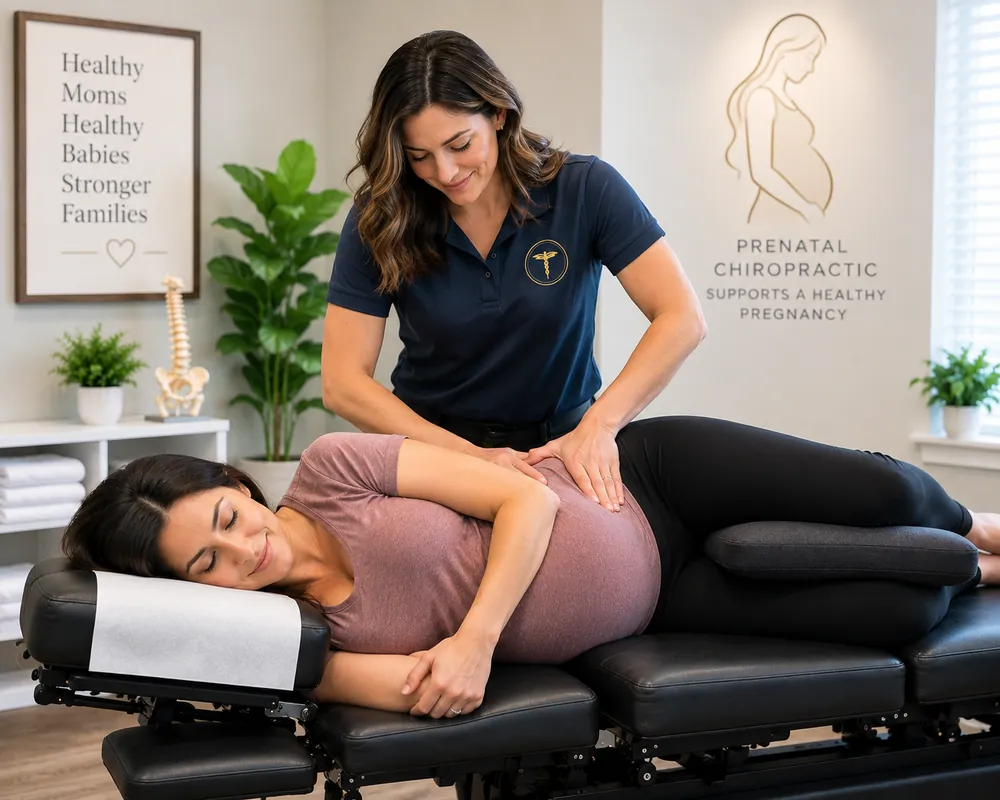
Quick answer: Prenatal chiropractic care is gentle, hands-on, drug-free care of the spine and pelvis during pregnancy. At Munroe Chiropractic in Williamsville, NY, Dr. Safeya Muhammad is Webster Technique certified and CACCP certified through the ICPA, using pregnancy-friendly tables and light adjustments to help expectant mothers stay comfortable and mobile. Call or text (716) 632-4476.
What Prenatal Chiropractic Care in Williamsville, NY Actually Involves
Prenatal chiropractic care is hands-on, drug-free, non-invasive care of the spine, pelvis and surrounding soft tissue during pregnancy. The goal is simple and practical: help your body carry a growing baby with as little strain and stiffness as possible. It is not a treatment for pregnancy itself, and it never replaces your obstetrician or midwife. It is supportive musculoskeletal care that works alongside your prenatal medical team, focused on how your joints move and how comfortable you feel getting through an ordinary day.
At Munroe Chiropractic, P.C. at 6035 Main Street in Williamsville, NY, prenatal visits look different from a standard adjustment appointment. The tables are set up for a pregnant body, with belly support or adjustable drop pieces, so you are never asked to lie flat on your stomach or twist in a way that feels wrong. The contacts are lighter. The pace is slower. Nothing is done without explaining it first, because a comfortable, relaxed patient is easier to adjust and gets a better result than a patient bracing against the table.
Every expectant mother who comes to our Williamsville office is treated as an individual case. A woman at eight weeks with sacroiliac pain from a pre-existing injury needs a very different plan from a woman at 36 weeks with rib pain and pubic symphysis discomfort. That is the whole point of a personalized exam rather than a one-size-fits-all protocol.
- Gentle, low-force adjusting suited to pregnancy rather than standard full-force technique
- Pregnancy-friendly table setup with belly support so you are never face down on a firm surface
- Soft tissue work for the hips, glutes, low back and round ligament area
- Home stretches, sleeping positions and posture guidance you can actually use
- No X-rays during pregnancy, and no medication of any kind
Why Pregnancy Puts So Much Load on the Spine and Pelvis
Pregnancy changes the mechanics of your body faster than almost anything else in adult life. As the uterus grows forward, your center of gravity moves with it, and the lumbar curve deepens to keep you upright. That increased curve loads the joints of the low back and shortens the muscles along the spine while lengthening the abdominal wall that normally helps support it. Many women feel this first as a dull ache at the belt line late in the day.
At the same time, hormonal changes including relaxin increase ligament laxity so the pelvis can accommodate birth. That is a necessary and healthy adaptation, but looser ligaments mean the sacroiliac joints and the pubic symphysis rely more on muscle control and less on passive stability. When one side starts moving differently from the other, you get the familiar pattern of pregnancy-related pelvic girdle pain: sharp catches when rolling over in bed, pain climbing stairs, a hitch when getting out of the car, or a deep ache into one buttock.
Sciatic-type symptoms are also common, usually beginning in the second or third trimester as the growing uterus and the shifting pelvis add pressure and tension around the nerve pathway. Add a job, older children to carry, and a Western New York winter of shoveling and slippery sidewalks, and it is easy to see why so many women in Williamsville, Amherst and Clarence look for a non-invasive option that does not involve medication.
- Forward shift in center of gravity and an increased low back curve
- Ligament laxity from relaxin, which reduces passive pelvic stability
- Sacroiliac and pubic symphysis irritation, often worse on one side
- Sciatic-pattern pain, tingling or numbness down a leg
- Mid-back and rib discomfort as the ribcage flares in later trimesters
- Neck and upper back tension from altered sleep and changing posture
The Webster Technique and Our Certified Training
The Webster Technique is a specific chiropractic sacral analysis and gentle diversified adjustment developed with the pregnant patient in mind. As defined by the International Chiropractic Pediatric Association, its goal is to reduce the effects of sacral subluxation and sacroiliac joint dysfunction so that biomechanical function through the sacral and pelvic region is improved. In practice it pairs a precise, light sacral adjustment with soft tissue work over the round ligament and related pelvic attachments, with the aim of improving how evenly the pelvis moves and how balanced the surrounding tension is.
Dr. Safeya Muhammad, D.C. leads prenatal and pediatric care at our Williamsville office. She is Webster Technique certified and CACCP certified through the ICPA, which is an advanced credential in pregnancy and pediatric chiropractic, and she has completed Spinning Babies training, an approach built around balance, gravity and movement to support maternal comfort. She has been with this practice for 11 years, so many of the families she cares for now first came to her during a pregnancy years ago.
We want to be straightforward about the evidence. Systematic reviews of chiropractic care for pregnancy-related low back and pelvic girdle pain have reported favorable but inconclusive results, and research on fetal positioning outcomes specifically is limited. What the literature does consistently show is that this kind of care is generally well tolerated in pregnancy and that patients frequently report meaningful relief of musculoskeletal pain. We will tell you what we can reasonably expect to help with, and what falls outside our scope.
Symptoms Expectant Mothers Bring to Our Williamsville Office
Most women who come to us for prenatal chiropractic care are not looking for anything exotic. They are looking for a way to sit through a workday, sleep more than two hours at a stretch, or pick up a toddler without a jolt through the hip. Pain is the most common reason for the first visit, and improved daily function is the reason people keep coming back through the rest of the pregnancy.
We commonly see low back pain, sacroiliac and pelvic girdle pain, pubic symphysis discomfort, hip and glute pain, sciatic-pattern leg symptoms, upper back and rib pain, neck pain, tension headaches, and the general stiffness that makes basic movement feel like work. Some patients also arrive with a pre-existing issue, such as an old disc problem or a prior auto accident injury, that pregnancy has aggravated. Because our office also handles no-fault, workers' compensation and personal injury care, those histories are familiar territory for us.
There are also situations where the right answer is a phone call to your OB or midwife rather than an adjustment. Vaginal bleeding, leaking fluid, severe or sudden abdominal pain, fever, significant swelling, a severe headache with visual changes, or decreased fetal movement are all reasons to contact your medical provider first. We say that plainly at the first visit, and we would rather send you to the right place than treat something outside our lane.
Step by Step at Your First Prenatal Visit in Williamsville, NY
Your first appointment is a consultation and examination, not a rushed adjustment. We start by talking: how far along you are, what hurts, when it started, how it behaves through the day, how you are sleeping, what your work and home demands look like, whether this is a first pregnancy, and how any previous pregnancies or births went. We ask who your OB or midwife is, and whether there have been any complications so far. That conversation shapes everything that follows.
The examination is hands-on and low-tech. We look at posture and gait, assess how the pelvis and spine move, check muscle tone and tenderness through the low back, glutes and hips, and use orthopedic and neurological screening as appropriate for pregnancy. We do not take X-rays during pregnancy. Our on-site digital X-ray equipment is used for other patients when imaging is clinically indicated, never for expectant mothers.
If care is appropriate, we explain the findings in plain language, describe what the adjustment will involve, and get your agreement before we do anything. The first adjustment is typically gentle and brief, often including sacral and pelvic work along with soft tissue release, followed by simple home instructions. Then we set a realistic plan. Many patients start with a short series of visits to calm things down, then move to a steadier rhythm through the remainder of the pregnancy, often increasing frequency in the final weeks when the load is greatest.
Before your visit you can complete your new patient paperwork on our Paperwork page, so we spend your appointment time on you rather than on a clipboard. To get started, call or text (716) 632-4476.
- Consultation and full pregnancy and health history
- Hands-on postural, spinal, pelvic and soft tissue examination
- No imaging during pregnancy
- Findings explained before any care begins
- Gentle first adjustment plus home care instructions
- A visit plan matched to your trimester and your symptoms
Safety, Comfort, and What an Adjustment Feels Like
The most common question we hear is whether adjustments are safe during pregnancy. Chiropractic care in pregnancy is widely used and generally well tolerated, and best-practice recommendations exist specifically for the care of pregnant and postpartum patients. That said, safety in practice depends on the doctor modifying technique for the pregnant body, screening properly, and knowing when to refer. We do all three.
Adjustments during pregnancy are lighter than what many people picture. We often use low-force and drop-table methods such as Thompson Drop, along with flexion-distraction, gentle diversified contacts and trigger point work. There is frequently no dramatic twisting and often no audible pop at all, and the absence of a pop does not mean the adjustment did not work. Most patients describe the sensation as firm, brief pressure followed by a feeling of release. Mild temporary soreness afterward, similar to how you feel after stretching a stiff muscle, is the most common reaction and typically fades within a day.
You will never be positioned face down on a flat, hard table. Belly support, side-lying positioning and adjustable table sections keep pressure off the abdomen throughout. If any position is uncomfortable, tell us and we will change it. There are also circumstances in which we will hold off on care and communicate with your OB or midwife first, including high-risk pregnancy complications, placental concerns, preeclampsia, unexplained bleeding, or any acute obstetric symptom. Deferring to your medical provider is not a limitation of our care, it is part of it.
Trimester by Trimester, and Care After Delivery
Care changes as pregnancy progresses. In the first trimester, many women feel relatively few mechanical symptoms, though those with a prior back or pelvic injury may notice it flaring early. This is a good window to address existing problems while positioning is still easy, and to establish a baseline before the bigger structural changes arrive. Fatigue and nausea are common, so visits are kept short and low-key.
The second trimester is when the mechanical load really begins to show. The lumbar curve deepens, ligament laxity increases, and sacroiliac and pelvic girdle complaints become the leading reason for visits. Side-lying positioning becomes standard, and pelvic and sacral work usually becomes the core of care. The third trimester brings rib and upper back discomfort, more pubic symphysis irritation, restless sleep and, for many patients, a preference for more frequent visits as delivery approaches. This is also when comfort measures, positioning advice and soft tissue work matter most.
Care does not need to end at delivery. The postpartum period brings its own mechanical demands: hours of feeding in a flexed posture, carrying a car seat on one side, lifting from a crib, and a core and pelvic floor that are still recovering. Many of our Williamsville patients return within the first few months after birth, and quite a few bring the baby along, since Dr. Muhammad also provides pediatric chiropractic care for infants and children.
How Prenatal Chiropractic Fits With the Rest of Your Care
Prenatal chiropractic care is complementary care. Your OB or midwife manages your pregnancy, your prenatal testing, your delivery plan and any medical complications. We manage joint mechanics and musculoskeletal comfort. Those roles do not compete, and we are glad to communicate with your provider when it helps. If you want to check with your OB before starting, we encourage it, and we can answer any question they have about what we do.
Inside our Williamsville office, prenatal care sits alongside other conservative, drug-free options. Massage therapy is coming soon to the practice and pairs naturally with pregnancy care. Cold laser therapy is not used during pregnancy. Our flagship Non-Surgical Spinal Decompression program, led by Dr. Niccole Jefferlone and Dr. Matt Millanti, is also not used during pregnancy, though it is often the right conversation for a disc problem before conception or after delivery.
Home care is a real part of the plan, not an afterthought. We will show you specific stretches, walking and movement guidance, sleeping positions with pillow support, advice on sitting and standing through a workday, and safe lifting mechanics for the toddler who does not care that your back hurts. Patients who do the small daily things generally need fewer visits, and that is the outcome we want.
Why Choose Munroe Chiropractic in Williamsville, NY
Munroe Chiropractic, P.C. has been caring for Western New York families since 1987, and more than 40,000 patients have come through our doors in that time. Since 2026 we have been part of the Complete Care Chiropractic family, with the same team in the same building at 6035 Main Street in Williamsville. Our approach has not changed: experience, quality and compassion, delivered through hands-on, drug-free, non-invasive care.
For expectant mothers, the practical advantages matter. Dr. Safeya Muhammad brings Webster Technique certification, CACCP certification through the ICPA and Spinning Babies training, with 11 years at this practice. Our full team includes Dr. Niccole Jefferlone, D.C., the owner, Dr. Matt Millanti, D.C., and Dr. Megan Berndt, D.C., who joined in 2026 with a master's degree in sports rehabilitation. That depth means your care does not stop at pregnancy. Whatever comes next for your family, from a pediatric visit to an auto accident injury, is handled in the same office.
We are open six days a week, Monday through Friday from 8:00am to 7:00pm, closed from 1:00pm to 2:00pm for lunch, and Saturday from 8:00am to 2:00pm. Those hours exist because pregnancy pain does not schedule itself around a nine-to-five office. We also have deep experience with no-fault auto accident claims, workers' compensation and personal injury care, which is useful if your symptoms began with a crash or a work injury before or during your pregnancy.
Appointments here are arranged person to person, and that is intentional. When you call or text (716) 632-4476, you reach real people who can answer questions about your situation, your insurance and how soon we can see you. New patient paperwork can be completed ahead of time on our Paperwork page.
- Serving Williamsville, NY and nearby Amherst, Clarence, Buffalo and Western New York
- Webster Technique certified and CACCP certified prenatal care
- Pregnancy-friendly tables and gentle, low-force adjusting
- Open six days a week, including Saturday mornings
- No-fault, workers' compensation and personal injury experience
- Family care under one roof, from prenatal to pediatric to adult
Frequently Asked Questions
Is chiropractic care safe during pregnancy?
Chiropractic care is widely used during pregnancy and is generally well tolerated when technique is modified for an expectant mother, and best-practice recommendations exist for the care of pregnant and postpartum patients. Safety depends on proper screening, gentle positioning and knowing when to refer. We take a full pregnancy history at your first visit, we never take X-rays during pregnancy, and we will hold off on care and communicate with your OB or midwife if there are complications such as bleeding, leaking fluid, preeclampsia or placental concerns. If you would like to check with your provider before starting, we encourage it.
What is the Webster Technique, and does Munroe Chiropractic offer it?
The Webster Technique is a specific chiropractic sacral analysis and gentle diversified adjustment used with pregnant patients. As defined by the International Chiropractic Pediatric Association, its goal is to reduce the effects of sacral subluxation and sacroiliac joint dysfunction so that function through the sacral and pelvic region is improved, and it pairs a light sacral adjustment with soft tissue work around the round ligament and related pelvic attachments. Dr. Safeya Muhammad, D.C. at our Williamsville, NY office is Webster Technique certified and CACCP certified through the ICPA, and she has also completed Spinning Babies training.
Does a prenatal adjustment hurt?
Most patients describe it as firm, brief pressure followed by a sense of release rather than pain. Prenatal adjusting is lighter than standard adult adjusting and often uses low-force methods such as Thompson Drop and flexion-distraction, with soft tissue work for the hips, glutes and low back. There is frequently no twisting and often no audible pop, which is normal and does not mean the adjustment was ineffective. Mild temporary soreness afterward, similar to how you feel after stretching a tight muscle, is the most common reaction and usually settles within a day.
How will I be positioned if I cannot lie on my stomach?
You will not be asked to lie face down on a flat, firm table at any point. Our tables are set up for pregnancy with belly support and adjustable sections, and much of the care is done side-lying, which most patients find very comfortable through the second and third trimesters. If any position feels wrong, tell us and we will change it immediately. Comfort is not a courtesy here, it is part of getting a good result, because a patient who is tense is harder to adjust.
When in my pregnancy should I start prenatal chiropractic care?
There is no single right time. Some women start in the first trimester, particularly if they already have a low back, hip or sacroiliac problem they want addressed before the bigger structural changes arrive. Many start in the second trimester when pelvic girdle and low back symptoms typically appear, and others come in during the third trimester for comfort and mobility in the final weeks. Care can also continue after delivery, when feeding posture, lifting and carrying place their own demands on the spine. Call or text (716) 632-4476 and we can talk through where you are.
Can prenatal chiropractic care help with sciatica during pregnancy?
Sciatic-pattern pain, meaning discomfort, tingling or numbness that travels from the low back or buttock down a leg, is one of the most common complaints we see in the second and third trimesters. It often relates to a combination of pelvic mechanics, increased ligament laxity and pressure from the growing uterus. Gentle adjusting and soft tissue work aimed at the pelvis, sacroiliac joints and surrounding muscles may reduce that irritation for many patients. We will examine you first and be honest about whether we expect to help in your specific case.
Do I need a referral from my OB or midwife?
A referral is not required to be seen at our Williamsville, NY office, though we are always glad to work alongside your prenatal medical team and to communicate with them when it helps your care. Chiropractic care supports musculoskeletal comfort and joint function. It does not replace prenatal medical care, testing or your delivery plan. If you are being managed as a high-risk pregnancy, we will want to coordinate with your provider before beginning.
How do I arrange a prenatal visit in Williamsville, NY?
Call or text (716) 632-4476 and we will get you on the schedule. We handle appointments by phone and text so we can have a short conversation about what you are dealing with, your insurance and how soon you need to be seen. We are at 6035 Main Street in Williamsville, NY 14221, open Monday through Friday from 8:00am to 7:00pm with a lunch closure from 1:00pm to 2:00pm, and Saturday from 8:00am to 2:00pm. New patient paperwork can be completed beforehand on our Paperwork page.
Expecting and uncomfortable? Call or text (716) 632-4476 to arrange gentle prenatal chiropractic care in Williamsville, NY. Open six days a week.